

Between the Hands and the Machine
Leading Creativity in an AI-Shaped World
For the last five years, I’ve been designing in the space where human intuition meets machine intelligence. It started with Alexa Games, where we tried to shape emotional storytelling out of something that wasn’t human at all. It continued through the playful social experiences at Prime Gaming, and the global creative ecosystems I support at EA.
Somewhere in that journey, AI moved from an interesting experiment to a quiet, constant collaborator. Not replacing creativity, but orbiting it. Nudging it. Accelerating it. Challenging it.
And yet, I’m still someone who loves the physical world.
The tactile drag of the pen on paper in my journal. The uneven wash of color from a painted brushstroke. The rhythmic sound of a page turning at night. That feeling of something made slowly, intentionally, by human hands.
I’ve never believed we have to choose between the two.
AI is extraordinary in the same way that the printing press was extraordinary: not because it replaces craft, but because it changes the surface area where craft can live.
Over the years, I’ve seen AI help small teams find their footing, help nonprofits stretch limited resources, help global studios align faster, and help creative partners visualize ideas early instead of wrestling them into existence alone. I’ve also seen its limits up close; Moments where nuance dissolves, emotional truth goes missing, speed gets mistaken for quality.
That’s the tension we have to lead inside.
The future of creative work doesn’t belong to those who fear AI or blindly embrace it. It belongs to leaders who know how to hold both.
Leaders who can answer questions like:
What deserves to be made by hand?
Where does automation support story instead of flattening it?
How do we build systems that protect human expression while still welcoming innovation?
Where is speed helpful and where is slowness sacred?
These aren’t technical questions. They’re creative leadership questions.
Technology can analyze patterns, summarize meetings, generate variations, and test options faster than people ever could. Yet it can’t feel the weight of a character beat. It can’t sense when a moment needs silence. It can’t understand the emotional physics of a story.
That’s still our job.
The Creative Leaders of the next decade won’t be defined by how well they can prompt a model. They’ll be defined by how discerning they are. How curious. How intentional. How capable they are of holding space for both the handcrafted and the computational without letting either overshadow the heart of the work.
In my own practice, AI is most powerful when it expands possibility: when it frees teams from tedious overhead, bridges communication across time zones, and allows more room for iteration and play. It is most dangerous when it tries to collapse the space where human judgment, taste, and emotion belong.
So much of creative leadership today is learning to feel that difference.
We are entering an era where artists, designers, writers, engineers, producers, and players will all experience worlds shaped by a blend of human and machine authorship. This isn’t something to fear. It’s something to steward. We still get to choose what remains sacred.
AI will keep evolving. So will our tools. So will our responsibilities.
If we meet this moment with clarity, curiosity, and a bit of playfulness, we can build experiences in games, films, and interactive spaces, that feel alive, intentional, and emotionally resonant…no matter what fractional blend of intelligence comes from the machine.
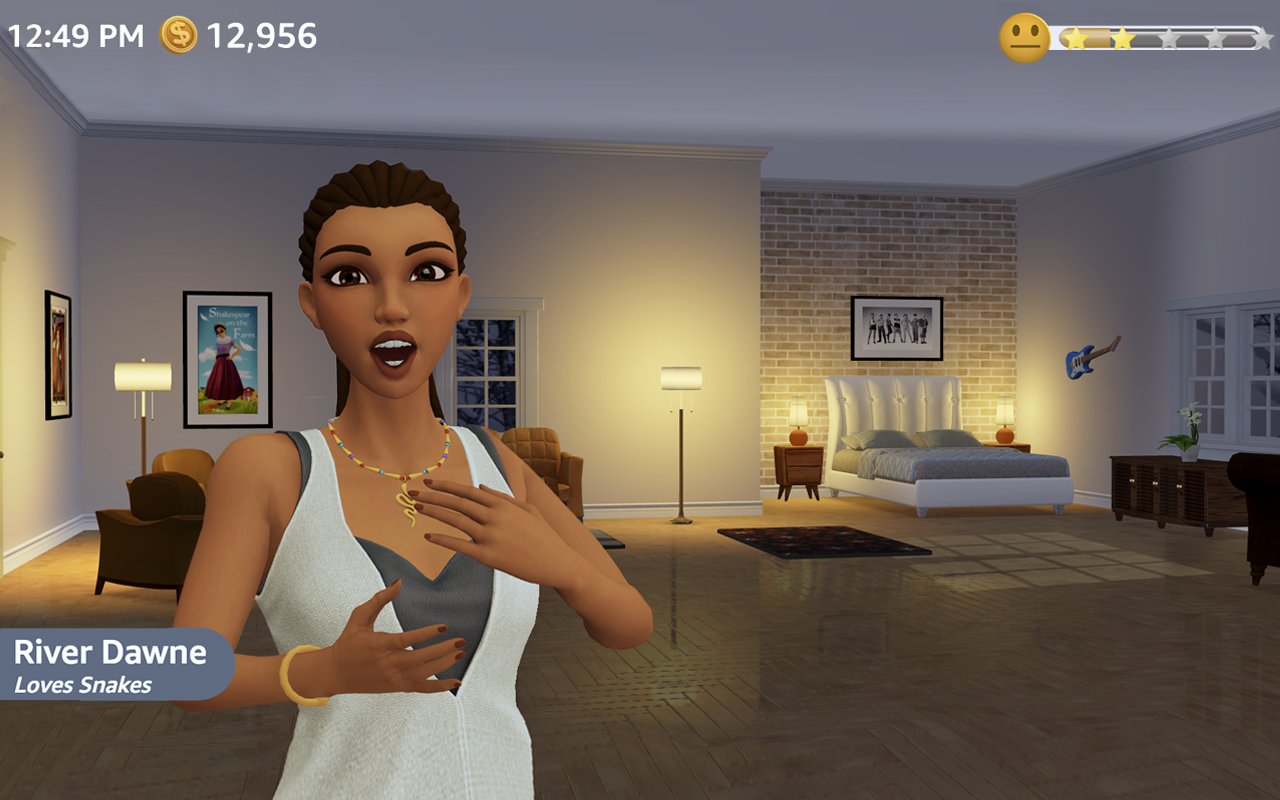
Chatting with an AI NPC in “My Loft” for Amazon Alexa Echo Show Device
